You are currently viewing Turn An old Cardboard Box To A whimsical Elephant Table For Free!

Turn An old Cardboard Box To A whimsical Elephant Table For Free!

Description

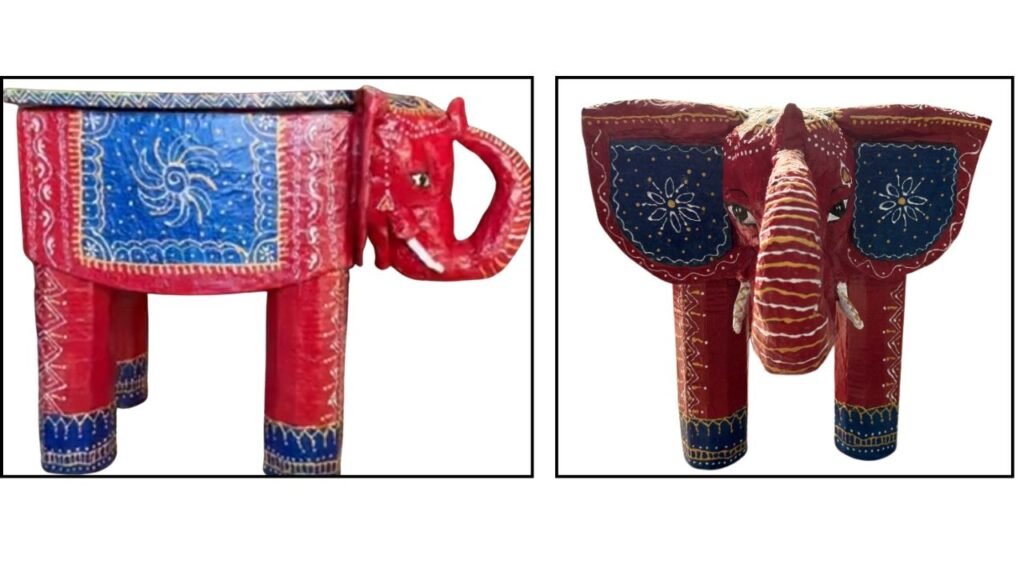
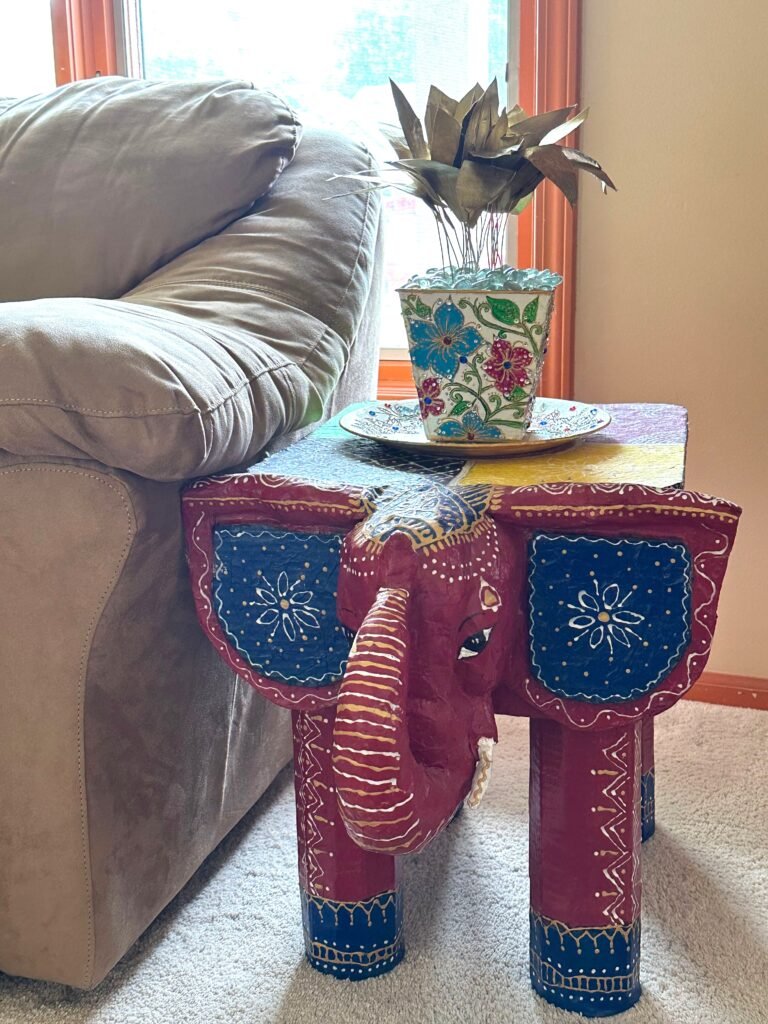
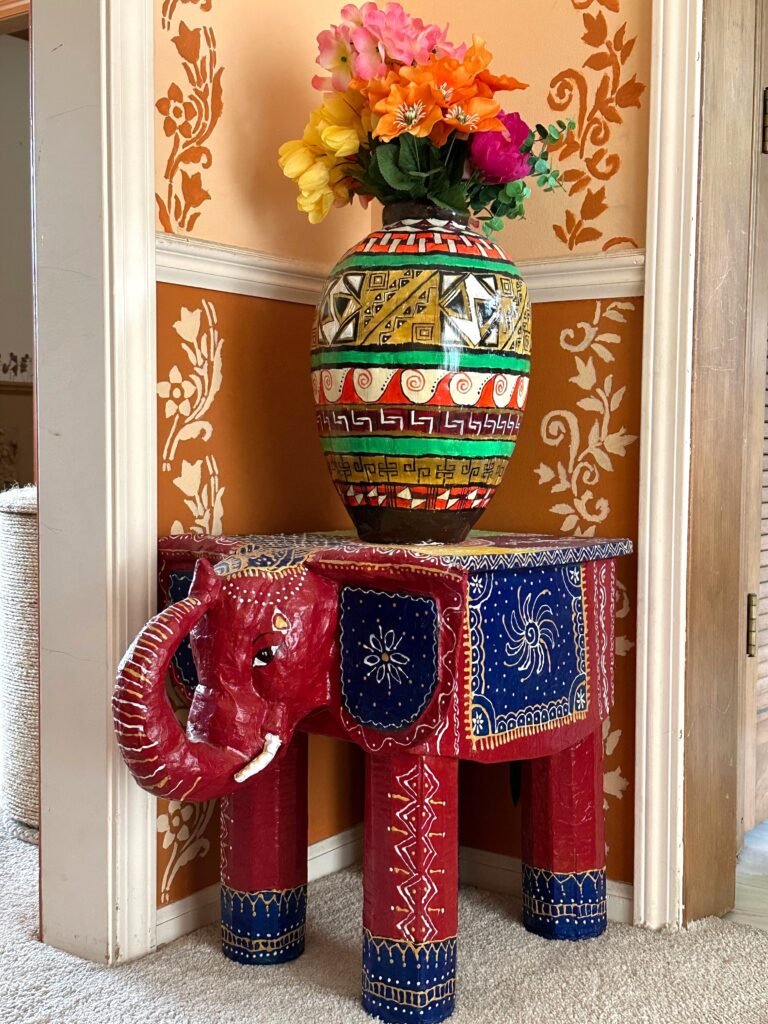
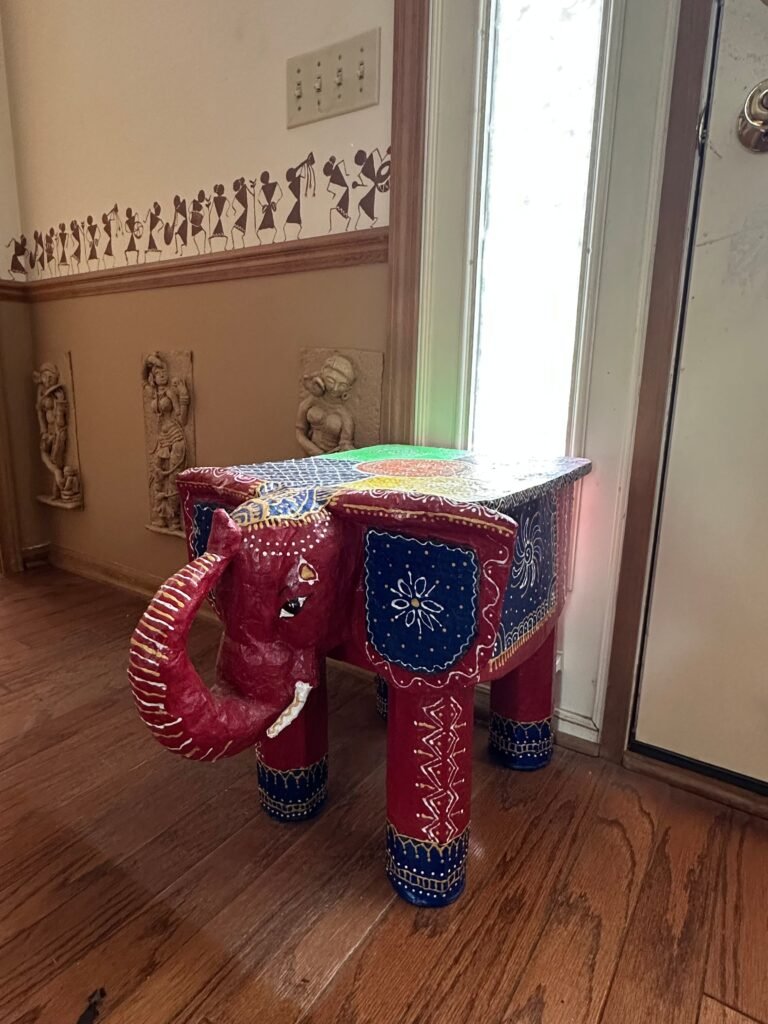
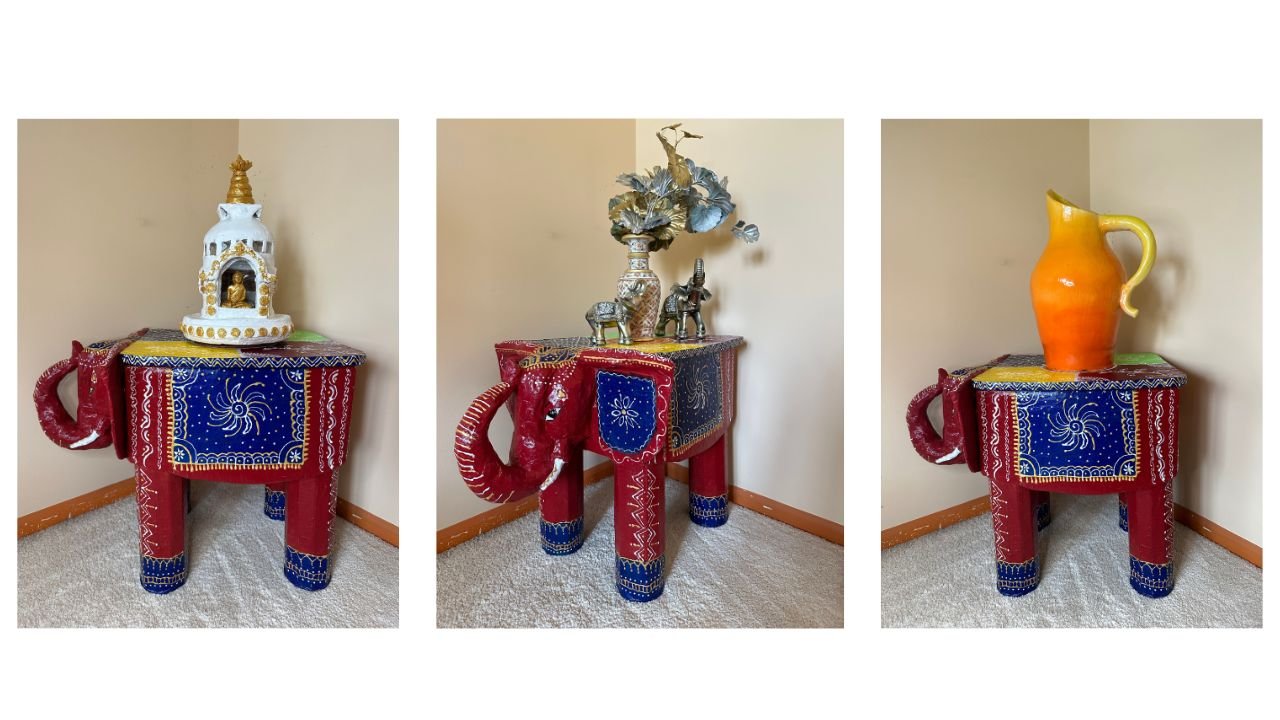
I made this whimsical elephant table using a cardboard box and grocery bags. I had paints I needed at home so yes, I made it for free.

This table may look difficult to make but trust me, its not difficult, the process of making it is elaborate. 

Materials Used

  1. A Cardboard Box
  2. Grocery bags
  3. Thick wire for sculpting
  4. Masking Tape
  5. Acrylic paints
  6. Outliner Paints (you can use Tulip dimensional)
  7. Paint Brushes
  8. School Glue
  9. Glue Gun
  10. Paper strips for paper Mache

Video Tutorial

This project is best understood by watching the step-by-step video tutorial below. I have included video timestamps with written instructions for your convenience.

Step-By-Step Written Instructions

Table Dimensions: H 19″ W14.5 L17

  1. I used a large cardboard box as the base for the tabletop, and it will also form the body of the elephant in this elephant table design. First, I sealed the bottom flaps that open outward with tape. Then, I glued the inner flaps firmly in place to strengthen the structure, making the box solid enough to support the tabletop. 

    To watch this step in action, watch the video at timestamp 0:17 to 0:54

2. Next, I shaped the box to form the body of the elephant. I drew curved lines on the longer sides to create the elephant’s belly and straight lines on the shorter sides to shape the front and back. Then, I cut the box following the drawn lines.

To watch this step in action, watch it in the video at timestamp 0:56 to 1:23

3. I fixed two cardboard sheets inside the box to make the body of the elephant  quite study so the table-top can take considerable of weight.

To watch this step in action watch the video at timestamp 1:24 to 1:42

4. Next, to make legs I took a sheet of cardboard. The length depends on how long you want the legs to be. Then I drew lines on the cardboard 1″ apart and  with the craft knife, I Scored the cardboard on the lines. I used ruler to make sure the scoring is done straight on the line.  After the scoring was done I folded the cardboard on the scored lines to make legs of the table.

5. I cut a cardboard circle with a diameter equal to the desired width of the table legs. I applied glue along the edge of the scored cardboard sheet and rolled it around the cardboard circle. After trimming off any excess cardboard, I glued the long edges together to close the pillar.

6. Next, For stability and weight, I filled legs with several grocery bags and closed the opening using another cardboard circle. Jere I used posterboard circle.

Watch making legs (steps 4 to 6) in action on the video. the timestamp is at 1:43 to 2:54

7. Next I got a sheet of cardboard Kept the box that I made body of the elephant with on the sheet. Drew a rectangle around the closed end of the box. Then kept legs in four corners of that rectangle. Drew a circle around the base of the legs. Took the leg off of the cardboard sheet. Then cut out the cardboard on the line. This is going to be the lid for the open side of the elephant’s body.

Below is the lid for the open side  of the elephant’s body.

8. I glued all four legs of elephant in its body. Then placed the lid I made (showed above) on the bottom of the table top.

Watch steps 7-8 in action on video.The timestamp is at 2:55 to 3:48

9. Next,I glued three foamboards together. The boards were a little bigger than the closed end of the elephant body or box. After the boards were stuck together edges were straightened out by cutting non aligned parts and sanding them.This is going to be the table top.

Watch step 9 on video. the timestamp is at 3:49 to 4:32

10. I glued brown paper pieces all over the table. This strengthened the structure and concealed the rough edges.

Watch Paper Macheing the whole structure in action on the video. 

The timestamp is at 4:57 to 5:20

11. Next, draw a ling in the center of the table top. I marked the center of the base as well. Then applied school glue on the base and glued the table-top on the base, matching the center lines.

To watch how to alignment of tabletop in action watch it on the video.

The timestamp is at 5:30 to 5:58

12. Once the table -top was fixed on the base, I started making elephant head. I started with a base template.

13. To make the armature for the elephant’s head, I wrapped newspaper into an oval shape and secured it with masking tape. I glued this oval in place on the cardboard elephant template. Then, I wrapped more newspaper to form the initial shape of the elephant’s trunk and glued it onto the oval. Then covered this structure with masking tape.

To watch step 13 in action watch it on the video

The timestamp is at 6:00 to 7:13

14. Next I made a hole at the base of the  trunk. Filled it with glue gun and inserted armature wire in the hole. Then, Wrapped newspaper on the wire. I wrapped the newspaper until I was happy with the thickness of the trunk.

15. Next I wrapped the head with masking tape.

Watch step 14-15 in action on the video.

The timestamp is at  7:16 to 8:35

16. Now Made lower lip of elephants mouth by wrapping the newspaper and covering it with masking tape. Glued the lip in place.

Watch step 16 in action on video. the timestamp is at 8:44 to 8:57

17. Next, I sculpted the ears to make them look more realistic. I rolled newspaper into a rope and glued it along the top edge of the ear, then covered it with masking tape. I cut a smaller size ear shape and  glued it in the center of the ear to add a little depth.

watch elephant ear making in action on the video.

Timestamp 8:36 to 8:42 and 8:58 to 9:02

18. Next, roll aluminum foil into the shape of an elephant tusk. Make a small hole in the elephant’s face where the tusk will be placed. Apply hot glue into the hole using a glue gun, then insert and secure the tusk in place.

Watch step 18 in action on the video.

The timestamp is at 9:16 to 9:36 

19. Once tusks are in place, I covered the elephant head in paper Mache by sticking brown paper pieces with school glue.

20. Next I applied School Glue as well as E6000 on the short side of the table and glued elephant head on it.

Watch the step 20 in action on the video.

The timestamp is at 9:43 to 9:59

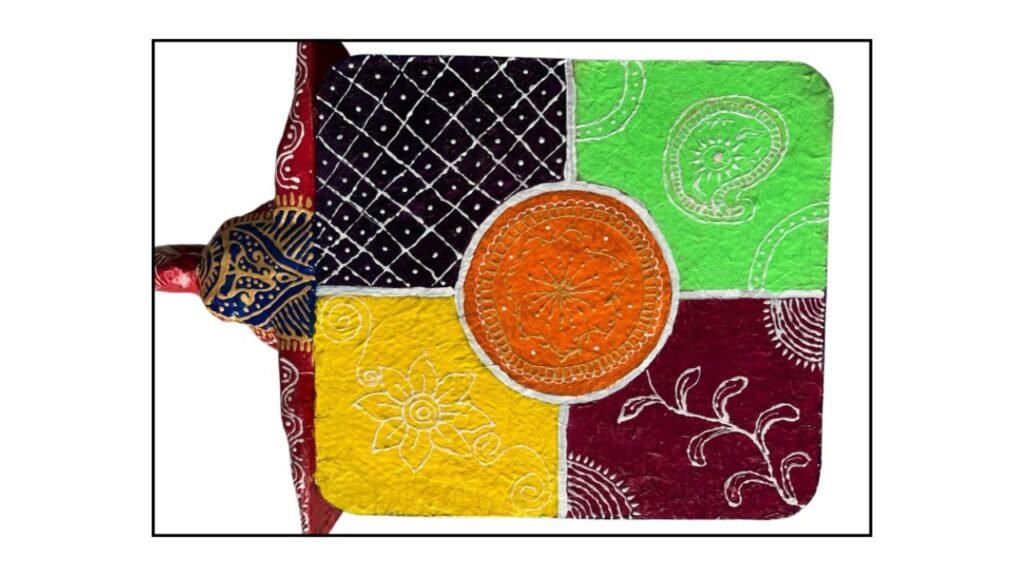
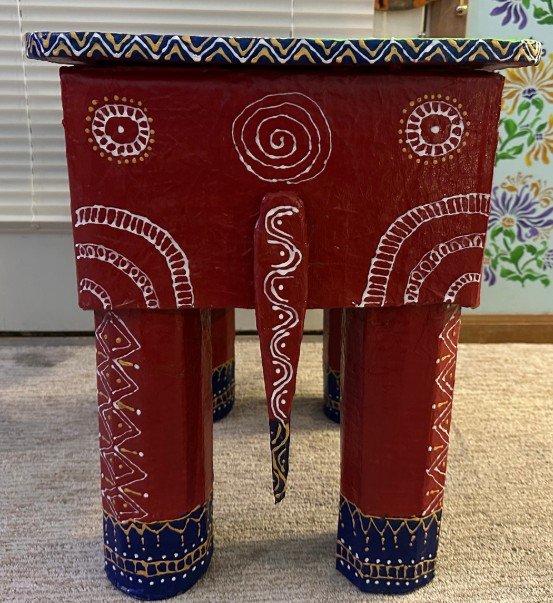
21. Now that the table is all done, I painted it with acrylic paints and when paints dried, I made decorative borders on the elephant with 3D outliners like dimentional Tulip paints. 

Watch step 21 in action on the video.

The timestamp is  at 10:00 to 10:47

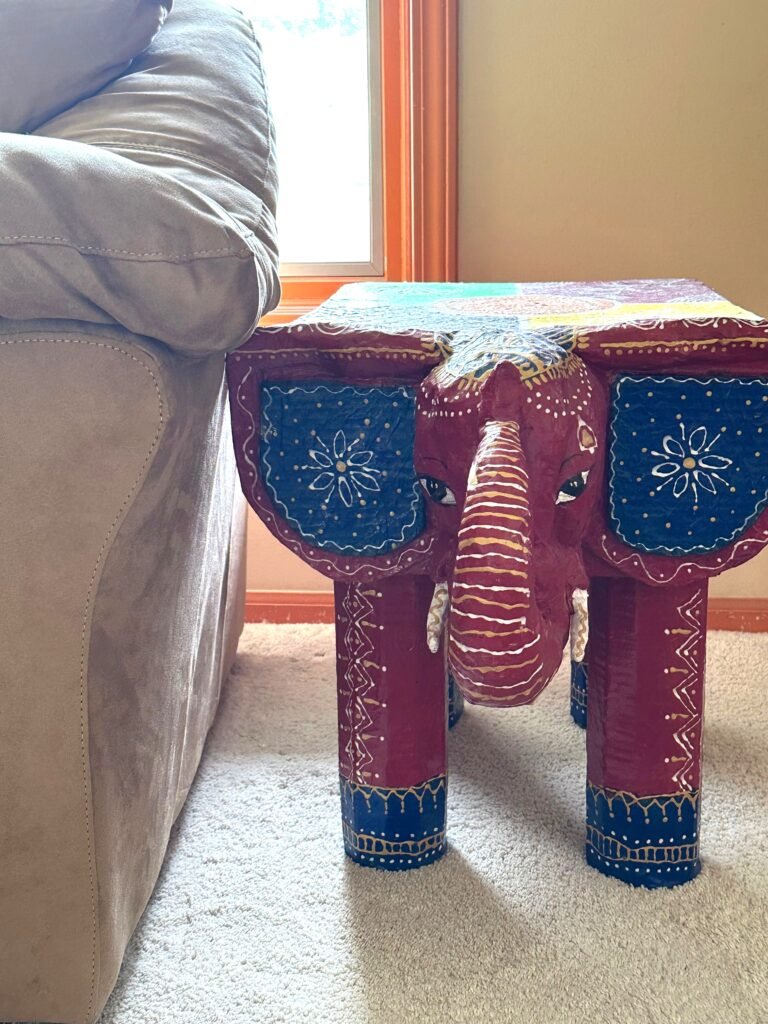
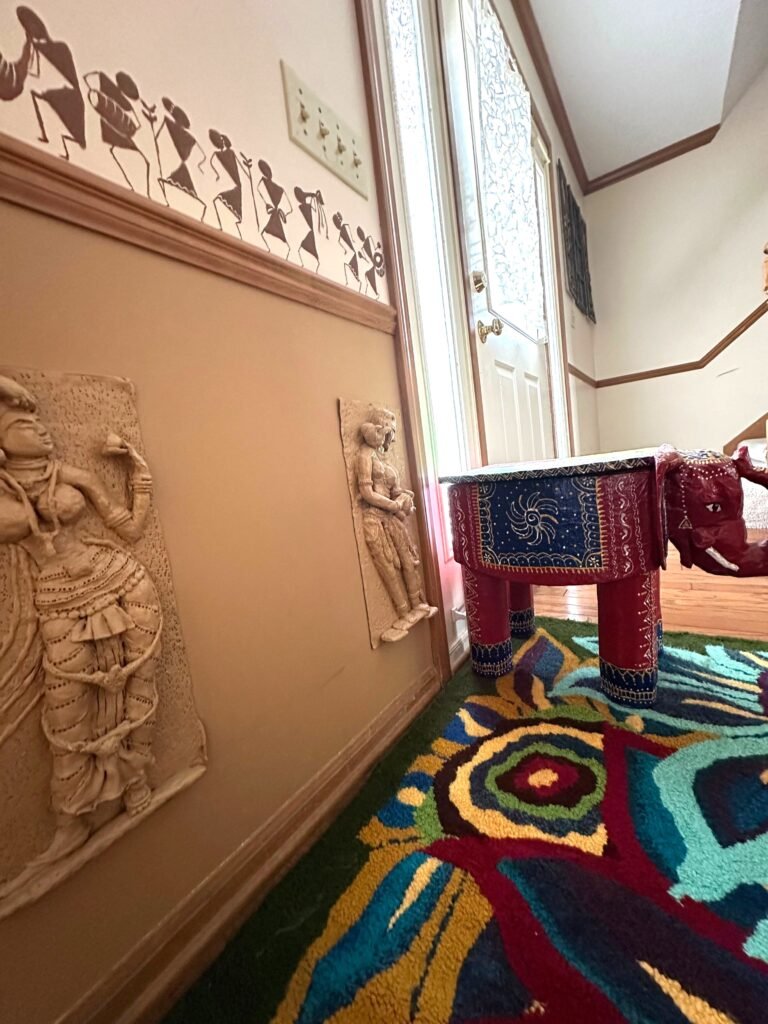
22. This is how it looks when it is all done.

You can watch it in the video in real time to see in different angles.

Timestamp for final result is at 10:50 to 11:15 

Tips And Tricks

  1. The table I created turned out a bit larger than I expected (about 20″ tall and 18″ wide from ear to ear of the elephant). Because of its size, it was a lot of physical work and at times a bit taxing. If I were to make it again, I’d probably go smaller. It would be easier to handle without losing its charm.
  1. Another thing I noticed is that I didn’t use spackling paste, which left the surface with a more textured, handmade look. If you’d like a smoother, polished finish, adding spackling paste would really help.
  2. Finally, while this table could easily be painted to mimic a wood-like finish, I went with a colorful design. I wanted it to feel whimsical and playful, even though it’s furniture. That’s the fun part! You can really make it your own.


Backstory

I recently discovered a beautiful elephant stool online and instantly fell in love with its design. Although it was made of wood, I knew I could recreate it using materials I already had at home.

By repurposing cardboard boxes and grocery bags, I created my own version of this piece. While the original was a stool, my version turned out to be a strong and unique table, made at zero cost. Proof that creativity truly matters more than expensive materials!

Final Word

I hope you enjoyed making this whimsical table! It’s completely customizable in both size and style, and the best part is that it can be made almost for free.

I’d love to hear your thoughts. please leave a comment below. For more creative DIY projects, consider subscribing to my blog and receiving craft ideas through my newsletter.

I also have several cardboard furniture projects on my blog, so be sure to check those out as well. You might feel inspired to create one of your own.

Happy crafting and  Thanks so much for stopping by!”

To get updates when new posts go live and access to a subscriber exclusive newsletter, please subscribe below:

Leave a Reply